
When the System Becomes Natural
Bach, tuning, and the future of AI

PRELUDE
The lesson for AI safety is this: standards change when technology ruptures the old world. Defaults become invisible and invisible defaults shape the future.
So we look to the past through the lens of Music History, where Equal Temperament tuning changed how humans hear music.
Including you.
For the duration of your read, I encourage you to listen while you read.
Or listen, and then read. Or better yet: read, and then listen.
Enjoy this: my personal favorite piece from The Well-Tempered Clavier Book 2.
F Minor - Prelude and Fugue: BWV 881, performed by Piotr Anderszewski. [1]
FUGUE
Music History - 1700-1750 - Leipzig, Germany
Johann Sebastian Bach is the Thomaskantor (Director of Music) in Leipzig. [7]
By this point, he had been successful as a Composer, Organist, Keyboard player, Teacher, and active community member. He writes Music for many reasons. Church, Private Events, Mass, Personal use, and the one we focus on today: Instruction.
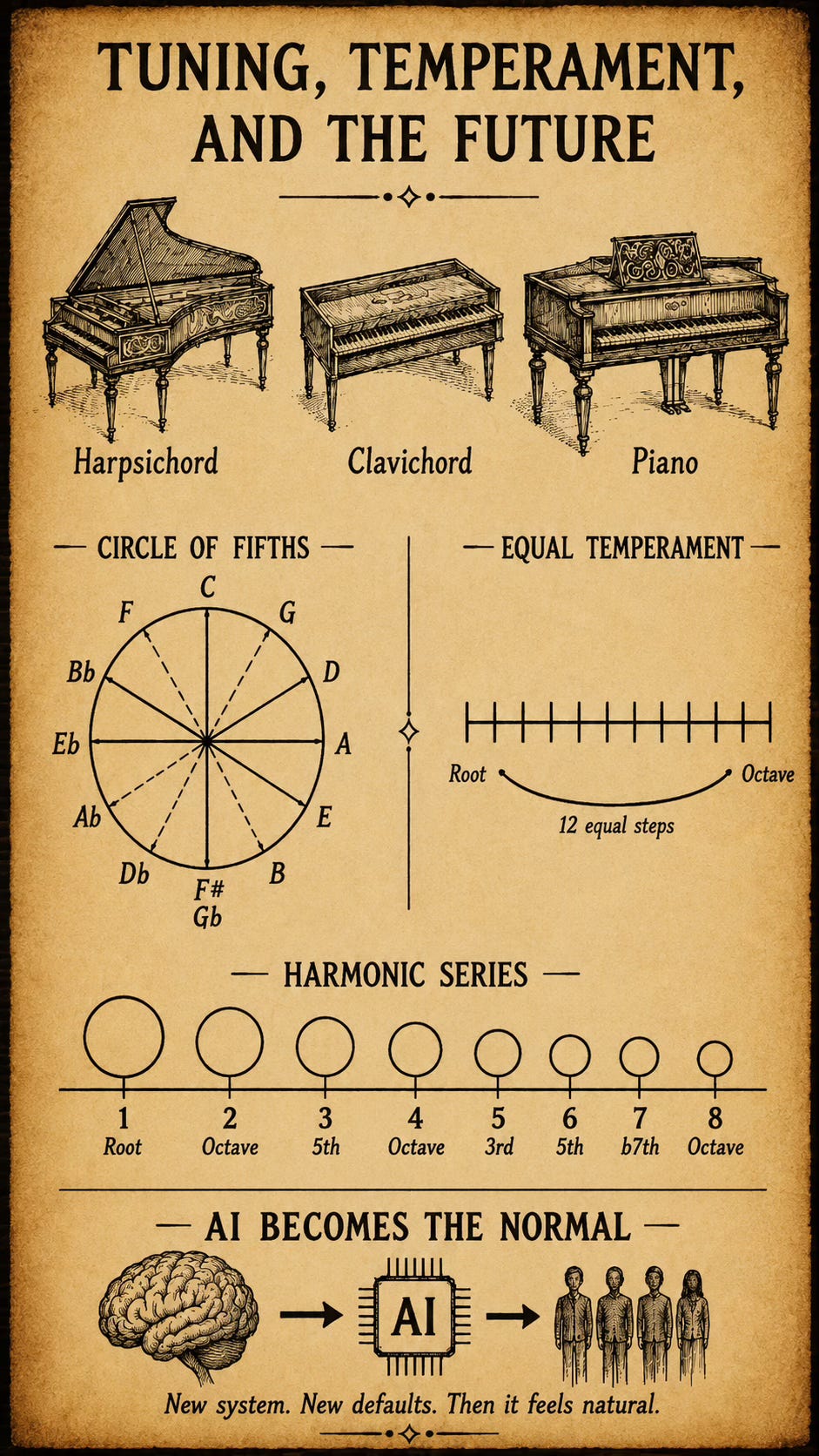
At the time, the modern Piano did not exist as the default keyboard instrument. It was the harpsichord, the clavichord, the organ, and early versions of what would become the piano. These instruments were not the same expressive machines we think of today.
The harpsichord, especially, is basically a fixed-attack instrument. You press a key, it plucks the string. You do not “lean into it” the same way you do on a piano. [2]
The clavichord is more delicate, and does allow some touch expression, but it is quiet. Intimate. Not built for the modern concert hall brain. [3]
But one thing was radically new at the time: Well-Tempered Tuning.
Not exactly the same as our modern Equal Temperament, but part of the same big historical move: making every key usable on a single keyboard. For the first time, a keyboard could move through all 12 divisions of the octave without certain keys becoming discordant.
So Bach, the keyboardist and teacher, needed a way to teach his students how to hear, think, and play across the entire system.
What does he do? He writes collections of pieces meant for Instruction: The Well-Tempered Clavier.
Preludes and Fugues. Every major key; every minor key. All 24 of them. 2 books, 48 pairs of a prelude and a fugue.
Trust me, you know WTC Book 1 - C Major - Prelude. Even if you think you do not, you do. It becomes the harmonic basis for the Ave Maria that everybody knows.
Lang Lang playing WTC Book 1 - C Major [10]
Now, why is this important to AI?
Because 300 years later, our brains have been conditioned to hear music through Equal Temperament.
Why is this a problem?
Despite common belief, the octave does not “naturally” split 12 ways equally.
Sure, you can split it that way, and we did exactly that. As a result of this, Keyboard Music became the baseline for the remainder of Western Music history.
String Orchestras, Brass Ensembles, and Choirs often use something closer to Pure Tuning (Just Intonation) in practice. [5] [6]
Why is this different? They bend the pitch, they adjust the pitch, they listen into the Harmonic Series: Root -> Octave -> 5th -> Octave -> 3rd -> 5th -> b7th -> Octave. This series is derived from sound fundamentals that use ratios to split the octave, instead of equally splitting the octave. [8]
Compare to this brass quintet piece: Irving Berlin - Putting on the Ritz by the Berlin Brass Quintet. Notice how often the players are bending the pitch. This is largely in part to the physical requirements and abilities the instruments themselves give. A keyboard has NONE of these abilities, it is forced into equal temperament because it lacks the ability to bend pitch. [11]
The point is that Equal Temperament is NOT the only option. But after 300 years, it feels so natural, you do not even notice! It is how most of us hear Music. Whether you are aware of it or not, you mostly listen to Music that is OUT of tune with the sound fundamentals, and only “in tune” to the system you inherited. [9]
That is the AI connection.
Models do not just learn reality. They become the NEW tuning system. They create compromises. They create defaults. They create interfaces. And then Humans adapt themselves around them.
Given enough time, the collective will forget there was ever a choice.
You already have. You read this whole thing listening through a tuning system you never agreed to and never knew existed.
This one. This was easy. It was only music.
[1] Bach - WTC Book 2 - F Minor Prelude and Fugue BWV 881. Piotr Anderszewski
[2] The Harpsichord
[3] The Clavichord
[5] Brass Acoustics
[6] Tuning Systems: Equal Temperament vs Just Intonation
[7] The Thomaskantor
[9] The Wolf at Our Heels - The centuries-old struggle to play in tune
[10] Bach - WTC Book 1 - C Major Prelude BWV 846. Lang Lang
[11] Irving Berlin - Putting on the Ritz - Berlin Brass Quintet
I really enjoy how you connect AI with music theory. It is fascinating to me that we force the circle of fifths to close. It shows that the octave scale is not really a circle at all but a logarithmic spiral—an open system (I wonder to what degree this reflects the geometry of the cochlea, and to what degree it reflects the physics of sound that the cochlea evolved to align with). It almost seems as though closure is forced to make it more “rational”instead of natural. Forcing the whole system out of tune in order to preserve an internal consistency. The map taking over the territory. I like where you are going with the corpus AI is trained on. And perhaps the geometry of the AI architecture itself. I wonder how flattening of the natural geometry might be related to hallucination.
Lovely article. I have always enjoyed explaining to hobby musicians that F-sharp is not the same as G-flat and that violinists actually play in tune, unlike pianists! The colour and overtones of just intonation are so valuable. And I love that F minor Prelude and Fugue, too. Fun fact, my mother taught one of Irving Berlin's granddaughters the piano for a few years! I think you're absolutely right about us getting used to AI in the same way that we now unthinkingly accept equal temperament as the norm.