
THE GREAT FLATTENING: PART 1
Music, Technology and the Displacement of Human Excellence

This is commentary.
I used AI for assistance. That is part of the argument. The writing, the images, the prompts, and my Human intentions are tangled together.
I aimed for a higher level of excellence, and that is the best I can hope for.
To the point, cold and fast:
Why hire a Human?
With a prompt, I received an image that looked like labor without requiring labor.
PRELUDE
What is your favorite kind of Music? When do you listen to Music? What is your parent’s favorite kind of Music? While you think on that, listen to this and read:
Hector Berlioz — Symphonie fantastique (1830)
V. “Songe d’une nuit du sabbat”
Performed by the Frankfurt Radio Symphony. [1]
In 1830, this was scandalous. It required a massive orchestra to depict the macabre.
As you thought about those questions, what were your answers? Where did Music take you? To a concert? To a song? To a movie? To a memory? To a person?
I would place my vote here: whatever you thought of, it probably involved a recording of Music, not a live performance. Even the Berlioz is a YouTube recording; I cannot escape this either.
Music is deeply personal in the twenty-first century because access to Music has been democratized. You are no longer limited to the Music of your village, your church, your family, your region, or your class. You can listen to almost anything. The world is available on command.
That was not always the case.
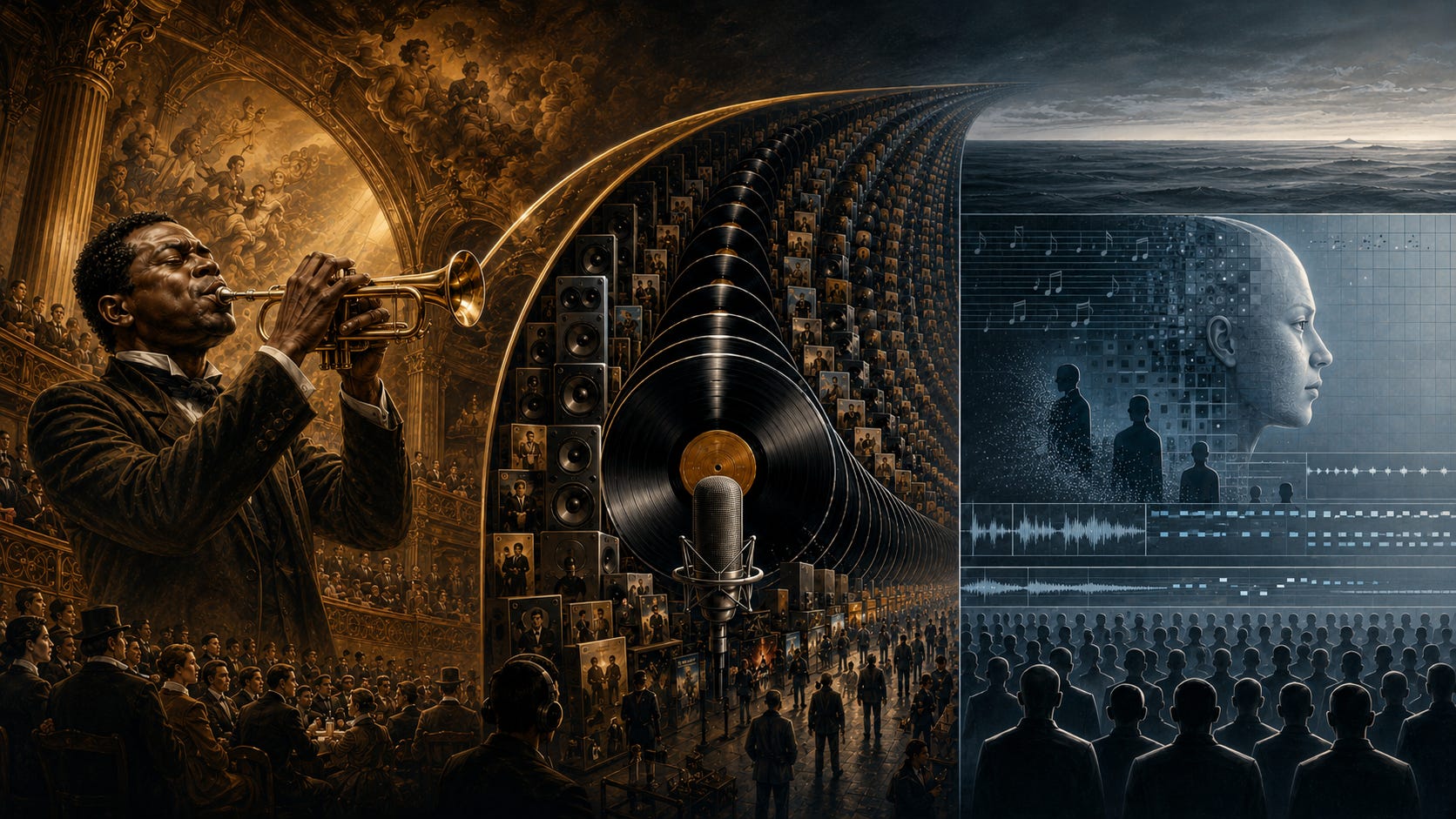
This is not an essay about musical taste. It is not about whether you like Berlioz, jazz, country, hip-hop, metal, hymns, film scores, or silence. It is about technological rupture. It is about what happens when a tool changes not only what Humans can make, but what Culture needs Humans for.
The structure is simple enough: three ruptures, three technologies, three changes in excellence. The brass valve. Recording technology. AI. Each one changes what culture asks of the Human. Each one changes the standard. Each one changes the distance between mastery and “good enough.”
I am Human, and therefore flawed. The flaw is not outside the argument. It is part of the show, and the show is what is at risk. Culture is not only made. It is performed, presented, received, and remembered.
The first rupture is the brass valve. It raised the standards of excellence by expanding what Human performers could do.
The second rupture is recording technology. It captured excellence, commoditized it, and raised the quality barrier of what counted as “good enough,” while lowering the cultural need for live performance. The balance shifted.
The third rupture is AI. AI does not merely distribute excellence or preserve it. AI threatens to remove excellence as an option because it can meet the commoditized standard of “good enough” without passing through Human mastery.
RUPTURE I:
THE VALVE AND THE RAISING OF EXCELLENCE
Prior to the nineteenth century, brass instruments did not function the way modern listeners imagine them. The chromatic freedom of the modern trumpet, cornet, flugelhorn, French horn, baritone, euphonium, and tuba was not simply waiting there in nature. [2] It had to be engineered. Brass valves changed what the instrument could do. They changed what the performer could attempt. They changed what composers could imagine.
The brass valve represents a kind of technological innovation that raised the standards of Human excellence.
It did not remove the musician. It demanded more of the musician.
The valve expanded the musical field. More notes became possible. More movement became possible. More timbral qualities became possible. The instrument became more capable, and as the instrument became more capable, the Human had to become more capable with it.
The technology raised the ceiling.
This is where Berlioz matters. Symphonie fantastique arrives at the front of this changing brass world. Its orchestral qualities: powerful, physical, theatrical, and intimidating. Even with modern day brass instruments, the point holds: the advent of the brass valve forever changed Western Art Music, and the performers had to step up.
The valve is not the enemy of Culture. It is an elevation of it.
A brass player still has to breathe. A performer still has to train the body. The lips, lungs, fingers, ears, and mind still have to coordinate under pressure. The sound still has to pass through Human discipline. A valve can change the length of tubing. It cannot create mastery.
That is why a brass ensemble performance remains physical as much as aural. The sound does not merely enter the ear. It hits the body. The volume, pressure, and size of the sound waves occupy the room. A recording can preserve the sound, but it cannot fully reproduce the physical encounter with Humans moving air in real time.
This is the first kind of rupture: the tool that extends the Human.
It raises the standard, expands possibility, and asks more of us.
The valve raised excellence because it made excellence harder, broader, and more necessary.
RUPTURE II:
RECORDING AND THE COMMODITIZATION OF EXCELLENCE
Recording technology created a different rupture.
Unlike the valve, recording did not primarily ask the performer to become more capable. It allowed the performance to survive the performer.
Before recording, Music required Human presence. If a community wanted Music, someone had to make it. A body had to be in the room. A tradition had to be carried through families, churches, schools, ceremonies, theaters, streets, and memory. Music was not merely an artifact. It was an event.
Recording changed that, and it was, for lack of a stronger word: a miracle.
A performance no longer had to die in the room where it happened. Sound could be captured. A singer, orchestra, soloist, or ensemble could be heard across time and distance. Excellence could be preserved, packaged, sold, streamed, replayed, studied, and remembered.
Recording democratized access to excellence, while commoditizing it.
Return to Berlioz’s Symphonie fantastique. The work premiered in 1830 and lived for nearly a century before it was first recorded in 1924 by Rhené-Baton conducting the Orchestre des Concerts Pasdaloups. [15] For nearly five generations, it survived through performance, rehearsal, notation, institutions, and bodies in rooms. That is the older form of cultural transmission: preservation through performance.
The recordings then took that piece even further. A work that once required orchestras, halls, conductors, and trained listeners became an artifact to be recalled on demand. By 1980, traces of its fifth movement had entered another medium entirely, film, through Stanley Kubrick’s The Shining. [16]
That is the second rupture in miniature. The event becomes the artifact. The artifact travels farther than the room ever could.
Walter Benjamin saw this rupture before digital culture made it ordinary. In 1935, he writes “The Work of Art in the Age of Mechanical Reproduction,” and he argues that reproduction changes the artwork’s aura: its unique presence in time, place, and tradition. [4] Recording does this to Music. It preserves the performance, but it also detaches the performance from the room, the performers, and the event.
Once excellence can be recorded, the standard of “good enough” changes. The listener is no longer comparing a local performer to another local performer. The listener is comparing everything to the best captured version available. Not just the best version in the town. Not just the best version in the church. Not just the best version the family could play. The best version in the world.
The recording raises the quality barrier for the artifact.
The public became trained to expect polish, precision, balance, editing, mixing, mastering, and repeatable perfection. The standard of the product rises. “Good enough” no longer means good enough to gather a room, hold attention, or serve a ritual function. It means good enough to compete with the commodity.
At the same time as blessing the world with sound, recording lowers the cultural demand for live excellence.
If the excellent performance can be played back on command, fewer people need to perform in order for Music to be present. Culture can be consumed without being practiced. It can be inherited without being learned. It can be remembered without being remade.
The artifact begins to replace the event. This is not speculative. In 1942-44, the American Federation of Musicians, under the guidance of James Petrillo, went on strike. [17] The “Petrillo Ban” banned instrumental recordings during the height of the big band and swing era. It was such a powerful strike from a union that the United States Department of Justice stepped in to stop it. [5]
This is the second rupture: excellence becomes a commodity.
Recording did not destroy excellence. That is not the argument. Recording may be one of the greatest cultural technologies in Human history. It preserved voices that would have vanished. It gave ordinary people access to extraordinary performances. It changed the world, and much of that change was good.
As history always shows us, even the best things come with a cost.
Recording shifted the balance. It raised the quality standard of the artifact while lowering the necessity of live Human performance. The best performance could now replace countless ordinary performances. The audience gained access to excellence, but the community lost some of its need to produce excellence locally.
Did recording cause the decline of Music Education? No, not by itself. History is never that clean. Teachers, students, ensembles, schools, churches, theaters, and local institutions are not extra. They are the Human supply chain of Music. They are how standards survive.
National Endowment for the Arts (NEA) data show that school-based arts education has followed a long-term pattern of decline since the mid-1980s, with the greatest declines in music and visual arts. [18]
So what happens when that chain weakens and the artifact survives?
Culture thins.
Recording technology forever changed Humanity.
RUPTURE III:
AI AND THE DISPLACEMENT OF EXCELLENCE
AI is the third rupture because it enters a culture already trained by recording to value the artifact over the event.
Recording taught us to accept Music without a musician in the room. Film taught us to accept performance without presence. Digital media taught us to accept endless reproduction as normal. Streaming taught us that Culture should be immediate, searchable, portable, and cheap.
AI only needs to meet the standard of “good enough.” That is where the danger lies.
It can generate the song without the musician, the image without the artist, the paragraph without the author, the voice without the singer, the performance without the performer. It does not need the body, the apprenticeship, the rehearsal, the room, the teacher, the failure, the lineage, or the years of becoming.
AI enters after that separation has become normal. It does not merely reproduce the artifact. It generates a new one that resembles cultural output without always passing through the same human chain of creation.
That chain matters.
Culture is not preserved by artifacts alone. It is preserved by the people and institutions that make, perform, record, teach, study, publish, credit, pay, and remember the work. Composer, performer, engineer, producer, publisher, teacher, student, scholar, amateur, professional, audience, archive, law: these are not decorative roles. They are the structure through which culture survives.
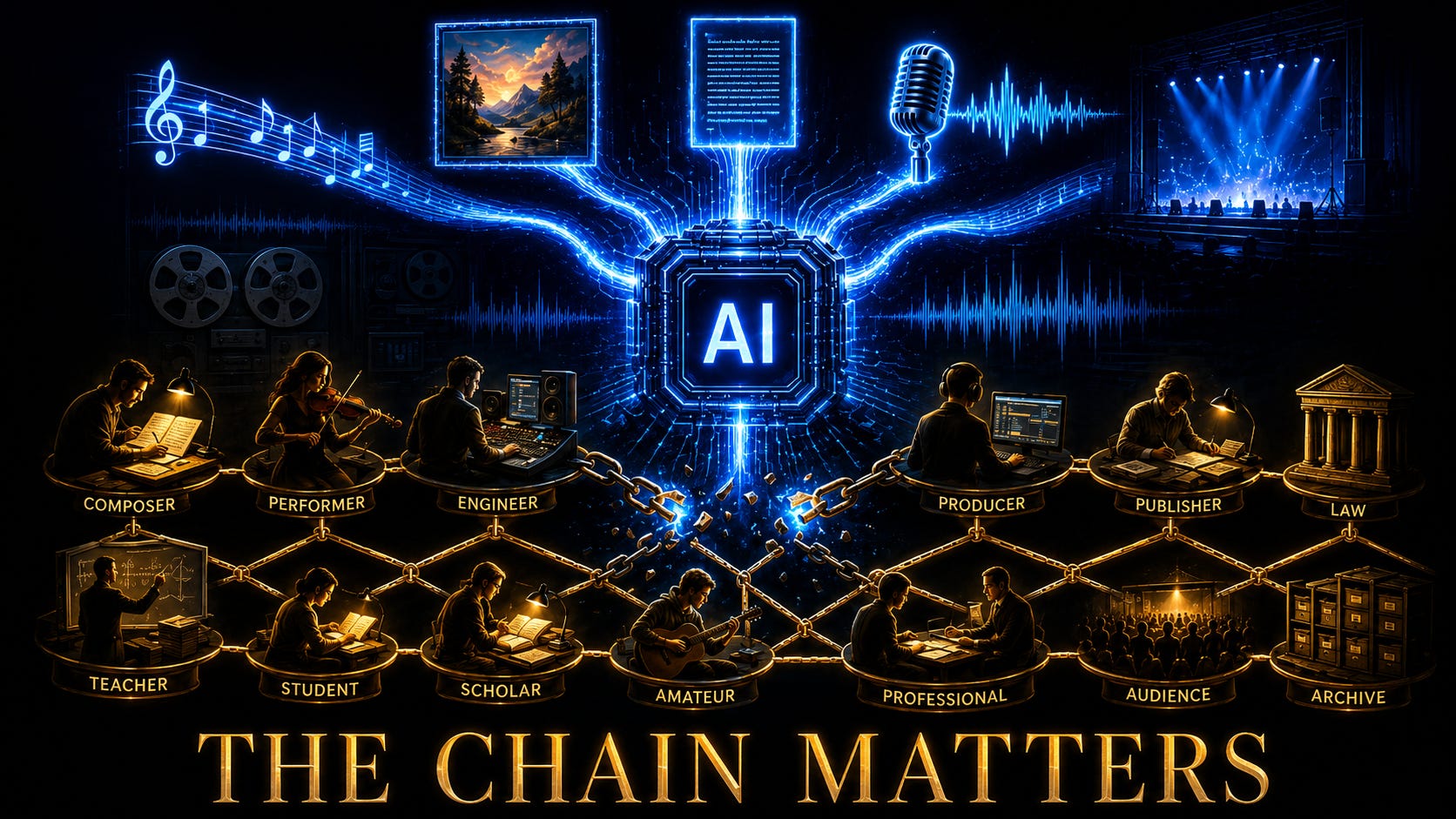
AI pressures that structure because it generates expressive material: text, images, audio, and video. Forms that resemble works traditionally protected by copyright. The U.S. Copyright Office describes generative AI as raising difficult questions about “the nature and scope of human authorship,” especially when human and machine contributions are mixed. [6]
We have already had two songs top charts that were AI generated:
Walk My Walk - Breaking Rust tops the Billboard and Spotify charts. [13]
Celebrate Me by IgnaRose hit number one song on iTunes. [14]
This is why the problem becomes legal as well as cultural. Copyright law is being forced to clarify where human authorship begins and ends. The Copyright Office’s 2023 guidance says the key question is whether the work is fundamentally one of human authorship. When a user gives only a prompt and the system determines the expressive details, the Office says the resulting AI-generated material is not protected as human authorship. [7]
The question is no longer only, “Who owns the work?” The question is where the human is located inside the work. Was the human the author, the editor, the prompt writer, the arranger, the curator, the performer, the source material, the rights-holder, the market, or merely the consumer? The Copyright Office’s 2025 report says purely AI-generated material is not copyrightable, that prompts alone generally do not provide sufficient human control, and that human contributions must be judged case by case.
That is the rupture.
AI does not simply create a new kind of artifact. It forces culture and law to ask how much human authorship, labor, judgment, and accountability must remain inside an artifact before the artifact can still be treated as human work.
Nothing here is settled, and that is the point.
AI is not dangerous because it always produces greatness. AI is dangerous because it can produce competence at scale. It can produce good enough faster than excellence can defend itself.
Not because Humans will stop making excellent work. They will. Not because AI will always outperform the master. It will not. People will continue to create things, but they will create without attribution, and without knowledge of the source material.
The threat is not the death of excellence. It is the normalization of its absence. Once a society accepts “good enough” where mastery used to matter, that expectation can spread beyond art into fields where the stakes are much higher.
This is no longer confined to art. Ford replaced its most experienced quality engineers with AI systems. The systems failed. The fix was not more compute. It was rehiring 350 "gray beard" engineers to retrain the machines and the juniors alike. The knowledge lived in the Humans. When they left, the standard left with them. [20] [21]
“We need to be clear about this: We are in a fight for humanity,” Fain said. “The fruits of our labor have multiplied like never before, but workers aren’t reaping the harvest. And if AI continues to be used as an accessory to that crime, it has to be stopped. It doesn’t have to be this way; in a just society, when workers create more value, they see more of the benefit.”
UAW president Shawn Fain [21]
THE GREAT FLATTENING
The Great Flattening is range contraction applied to culture. [8] In statistics, range is the distance between the largest and smallest values in a set. When the minimum rises and the maximum falls, the range compresses.
That is the cultural warning. The bottom rises toward competence. The top quality falls toward indifference. The distance between “good enough” and mastery contracts. Everything moves toward a new middle.
The bottom rising is an easy one to see. Customer service reports show gains with lower skilled personnel. [10] Even in the arts, creativity can be bolstered. [9] The benefit is not the focus here. The technology can do some amazing things.
The top is the concern, not the bottom. It loses its edge. Expert doctors, each with thousands of procedures performed, saw their unassisted detection rates fall after three months of AI assistance. [22] An MIT study suggests writers who compose with an LLM show weaker neural engagement. [23] If AI is to replace the experts, it cannot pass that knowledge through generations. Even the AI models collapse when trained on their own output. [24] The risk is Human.
That is the Great Flattening.
AI does not need to be better than the best. It only needs to be good enough for the buyer, good enough for the platform, good enough for the deadline, good enough for the advertisement, good enough for the feed, good enough for the client, good enough for the audience that has already been trained to value the artifact more than the Human event behind it.
That is the quiet harm of good enough.
The Great Flattening does not announce itself as destruction. It announces itself as access. Efficiency. Democratization. Productivity. Creativity for everyone. Faster workflows. Lower costs. Fewer barriers.
All of that may be true and that is what makes it dangerous.
The debate is not about whether or not the LLM has value. It is clearly a powerful force that can be harnessed. It is already becoming a tool that helps people create more than they could create alone, including this essay.
The arguments presented here are through Music History, but the core position is very simple. The question is whether AI becomes a tool that raises Human excellence, or a system that makes Human excellence economically unnecessary. The worst outcome is the normalization to a lower standard of excellence.
That is the rupture and the basis for the urgency. Consciousness is not the concern. Whether the AI has feelings or emotions is not the right question. It is about AI’s impact on the economic value of the Human.
AI may not need the Human in any meaningful way at all. Model output quality has already risen to dangerous levels. In some cases, it is better than “good enough.” The technological reproduction of good enough is the quietest weapon ever aimed at excellence.
The bar for excellence will move. Direction is the only question left. Up is possible; I hope for up. Hope is just a feeling, so we look to the mechanism.
Up requires attribution, institutions, teachers, law, and money.
Up must be built.
1942: rebuilding cost a two-year national strike. [5]
2018: rebuilding cost twenty years and an act of Congress (MMA). [19]
Down requires nothing at all, and is the default.
The risk extends far beyond the arts, and it is within the high-stakes fields where this exact kind of issue becomes existential.
This is the Great Flattening and it will not be painless.
Now listen to an unnamed AI-generated imitation, produced from a one-shot Suno prompt: [12]
Symphonie fantastique, Berlioz
Do we still need symphonies, orchestras, composers, performers, conductors, sound engineers, and virtuosi?
The AI artifact answers one question quickly: yes, a machine can produce “good enough.” Count me impressed. I do not discount the power of the technology. But the cost is not only economic. The cost is Culture.
The harder questions remain: Did this work survive generations of performance before recording? Where is the score? Who studied it? Who preserved it? What discipline does it transmit? What Culture had to exist before it could be made? Who was the conductor? Who is the composer? Who are the soloists?
Where is the attribution?
Decide for yourself.
TRAINING DATA TRANSPARENCY
United Nations Universal Declaration of Human Rights
Article 27 [11]
Everyone has the right freely to participate in the cultural life of the community, to enjoy the arts and to share in scientific advancement and its benefits.
Everyone has the right to the protection of the moral and material interests resulting from any scientific, literary or artistic production of which he is the author.
[1] - Berlioz: Symphonie fantastique ∙ hr-Sinfonieorchester ∙ Andrés Orozco-Estrada
[2] - The Evolution of the Orchestra: Brass
[4] - Walter Benjamin - The Work of Art in the Age of Mechanical Reproduction
[5] - The Silence Was Deafening What happens when musicians strike the record labels
[6] - U.S. Copyright Office - Copyright and Artificial Intelligence
[8] - NIST - Engineering Statistics Handbook - 1.3.5.6. Measures of Scale
[9] - Generative AI enhances individual creativity but reduces the collective diversity of novel content
[10] - Generative AI at Work
[11] - United Nations - Universal Declaration of Human Rights
[12] - Suno
[13] - AI slop tops Billboard and Spotify charts as synthetic music spreads
[14] - The No. 1 Song On U.S. iTunes—And Several Other Countries—Is AI Generated
[15] - ¡Fantástico! Here’s the Earliest Recording of Berlioz’s Drug-Addled Magnum Opus
[16] - Horror Music from ‘The Shining’ Main Title Explained
[17] - American Federation of Music - 125 Years: Musicians Staying Stronger Together
[19] - The Creation of the Music Modernization Act
[20] - Ford had to hire back former engineers to fix mistakes made by its automated systems
[23] - Your Brain on ChatGPT
[24] - Nature - AI Models Collapse When Trained on Recursively Generated Data