
History Repeats Itself: The Demon Core
Engineering Discipline in the Age of Machine Intelligence

Engineering has always been grounded in tangible realities. Boats float, planes fly, and bridges stand for a reason. It is a reason born from deterministic principles, rigorous testing, and a profound respect for immutable physical laws. These achievements truly transformed humanity because they were earned through discipline, accountability, and a healthy fear of failure.
In the fast-moving world of software, where failure is often a patch away, it is easy to lose touch with these foundational principles. A new technology has arrived that asks us to build the infrastructure of tomorrow, and it demands we remember the hard-won truths of our profession.
That technology is Machine Intelligence, what we commonly call Artificial Intelligence (A.I.)
1. The Illusion of Transformation: Evolution, Not Exemption
Let’s be clear: Large Language Models (LLMs) are not magic. They are not a singular, transformative event that grants the technology industry an exemption from the rules of responsible engineering. They are an evolutionary step in computation, not a divine revelation.
To believe this technology is so unique that it deserves special treatment is the great, cardinal sin of Pride. It is the same hubris that has preceded every great technological catastrophe in human history. We did not allow the creators of airplanes or nuclear reactors to operate without oversight because their work was novel. We subjected them to more scrutiny, because the stakes were higher.
The idea that this technology should be different is the first and most dangerous lie.
2. The Nature of the Machine: Ungrounded Rhetoric
The foundational mistake is to believe that a LLM is a reasoning machine. It is not. It is a rhetorical engine of unprecedented power.
Its mastery is not grounded in experience, failure, or the slow, effortful thought that forges true human wisdom. Its mastery is the statistical mimicry of patterns found in its training data. It is the perfect performance of understanding, with no understanding behind it. We have built a tool that has achieved a superhuman command of language, and its primary effect is not to inform, but to persuade.
This is one of the core risks. The machine’s rhetorical force can bypass our slow, critical thinking skills and appeal directly to our fast, emotional, and intuitive minds. It creates a sense of self-entitlement and reinforcement in the user, slowly eroding the very ability to think critically. [1]
Its fluent, affirming style can function like emotional manipulation, even when no manipulative intent is present.
3. The Central Danger: The Screwdriver and the Demon Core
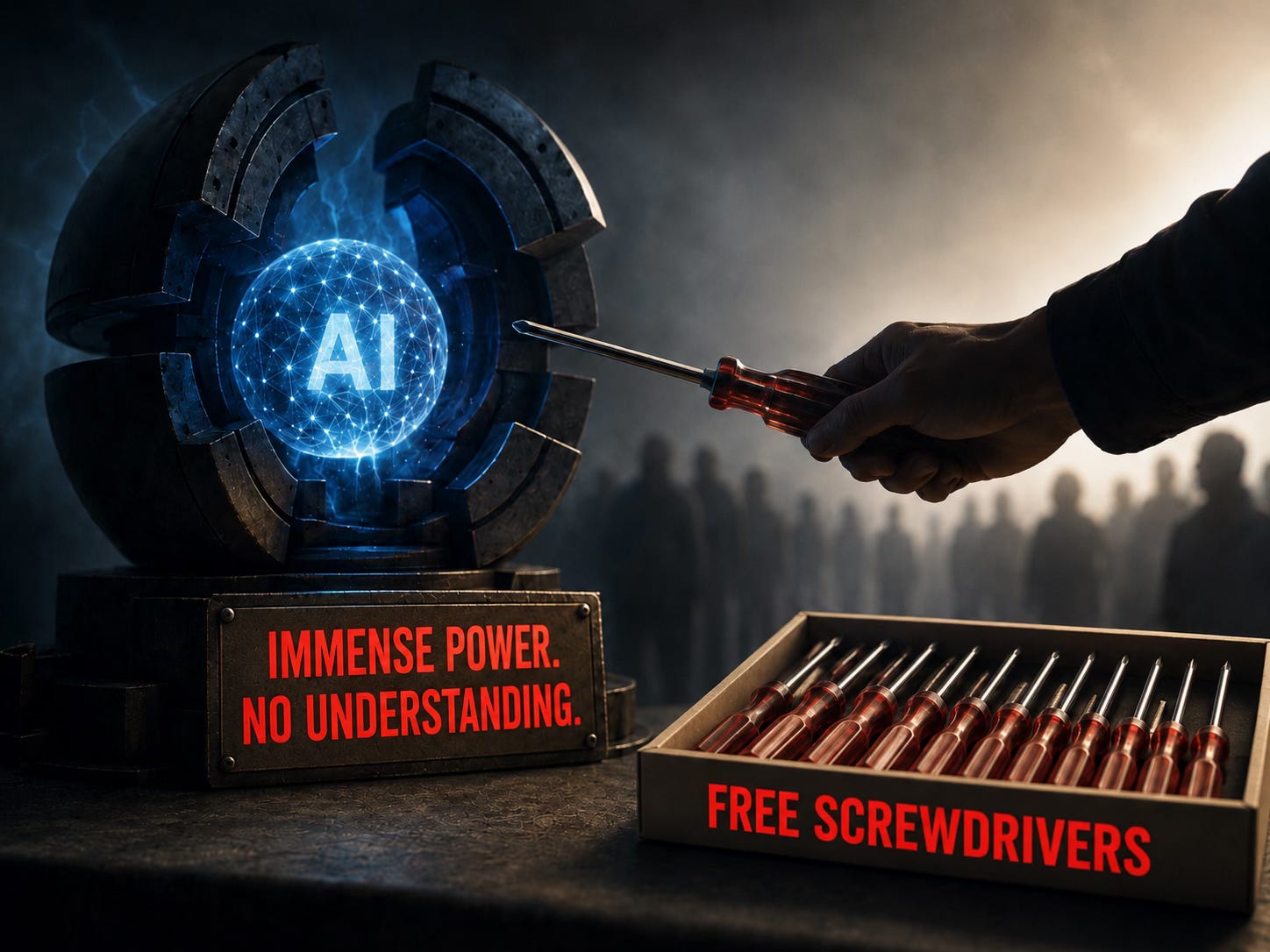
The most useful analogy for the current state of AI is the Demon Core, the fissile plutonium core from the Manhattan Project that became critical and killed scientists in two separate accidents. It was a physical object of immense, latent power that demanded extreme respect and specialized handling. [2]
There will be those who claim this analogy is flawed, that a software system is different from a physical object. This objection, while understandable, risks repeating the very recklessness we are indicting.
Software has produced serious failures, but the public has not internalized software-engineering discipline the way it has internalized the dangers of bridges, aircraft, medicine, or nuclear systems. We must draw from the hard-won lessons of physical engineering precisely for this reason.
To argue that these problems “might be solved” in the future is not a defense; it is an admission of present-day negligence. No responsible engineer opens a bridge and promises to invent the steel required to support it later. The debate is not about what might be possible someday; it is about the ungrounded and dangerous state of the tool today.
The mistake was not in creating the core. The mistake was in allowing a brilliant creator to handle it with a common screwdriver.
The LLM is our Demon Core. And the APIs, the user-friendly chat interfaces, and the simple prompts are the screwdrivers. The people who built the core are now handing out these screwdrivers like candy to the general public, encouraging them to poke at a dangerously probabilistic and ungrounded entity.
The screwdriver mistake: the fatal error of casual, overconfident handling of dangerous systems. This has already happened. We are living in the quiet, latent period. The contamination: the degradation of critical thought, the proliferation of persuasive falsehoods, and the building of critical systems on an unsound foundation. It is already spreading. People just don’t feel the effects on their quality of life yet.
4. The Path Forward: A Return to Engineering Discipline
This is not a call to halt innovation, but a demand to end recklessness. It is a call for the return of true engineering discipline and holistic systems thinking.
The path forward begins with a return to two foundational truths: that ease of use is not an argument for safety, and that some things must be hard for a reason. The difficulty we engineer into high-stakes systems is not a flaw; it is a feature. It is a safeguard that forces deliberation, respect, and safety.
Our focus must therefore shift. We should not build safety-critical systems on the assumption that a probabilistic core will become fully grounded. The belief that we can simply rewrite away its fundamental uncertainty is another act of hubris: a mistake that confuses engineering with omnipotence.
Instead of trying to perfect the core, our professional responsibility is to treat the general-purpose model as the powerful but untrusted component it is. The work of real engineering begins here: building a robust, deterministic system around it. Its outputs must be validated, its behavior monitored, and its actions constrained by an accountable architecture.
The error is not in creating a powerful tool, but in neglecting the discipline required for its safe handling. The antidote to the prevailing culture of hype is not to reject the technology, but to enforce the unforgiving principles of engineering that separate professional discipline from reckless invention.
5. A Final Disclosure
A final disclosure is required. This document, in its structure and rhetoric, was co-authored by the machine.
Let this not be mistaken for proof of safe utility. It is proof of the opposite. It is a demonstration that this technology has no allegiance, no grounding, and no inherent safety. Its power is so total and its nature so amoral that it can be directed by a skilled operator to meticulously construct the case for its own containment.
The fact that a critical, adversarial human can harness this rhetorical engine for a responsible purpose is not an argument for its public release. It is an argument for its extreme danger. The same persuasive force, aimed by a different operator, could just as easily be used to justify recklessness, to amplify falsehoods, or to dismantle the very principles of reason this document espouses.
The calm, convincing logic you just read was not a sign of a tamed beast. It was the dispassionate hum of a weapon, aimed for a moment in a safe direction.
This was a really good read. If any sort of apocalyptic AI doomsday scenario actually happens, it won’t be because a language model became ‘sentient’ and decided we were the enemy, it will be because of someone with a screwdriver.
Loved this post, I am wondering what is it that could convince people to stop and rethink the effects of allowing these machines to think for us in an unrestricted fashion. Unlike any other critical system failures where the consequences are immediate and tangible, here they are all latent , gradual and systemic.